
GST E-Invoicing and E-Way Bills: How MaxxERP Automates Compliance
Why GST Compliance Has Become a Daily Operational Task, Not Just an Accounting One
For years, GST compliance was something businesses thought about at return-filing time — a monthly or quarterly exercise handled by the accounts team. That’s no longer true. With e-invoicing mandates extending to smaller turnover thresholds and e-way bill requirements applying to routine goods movement, GST compliance now happens at the point of every sale and every dispatch, not just at month-end.
For a growing business, this means compliance can’t be a manual, after-the-fact process anymore. An invoice with a mismatched HSN code, a missing IRN, or a delayed e-way bill isn’t just an accounting inconvenience — it can hold up a delivery at a checkpost, invite penalties, or block your customer’s own input tax credit. MaxxERP builds GST e-invoicing and e-way bill generation directly into the billing and dispatch process, so compliance happens automatically as part of doing business, not as a separate task bolted on afterward.
What Manual or Disconnected GST Compliance Actually Costs You
Before looking at how automation helps, it’s worth naming what goes wrong without it:
- Invoices get raised in one system and then re-entered into a separate e-invoicing portal, doubling data entry and introducing transcription errors.
- E-way bills get generated late or forgotten entirely for time-sensitive dispatches, risking penalties or goods being held up in transit.
- HSN codes and tax rates get applied inconsistently across products, leading to mismatches during return filing.
- Reconciling GSTR filings against actual sales and purchase records becomes a manual, error-prone exercise every filing cycle.
- Businesses operating across multiple states or branches struggle to keep GSTIN-wise records consistent and centrally visible.
A GST-aware ERP is meant to remove these gaps entirely, rather than just making the accountant’s job marginally easier.
What GST Compliance Automation in MaxxERP Covers
E-Invoice Generation at the Point of Billing
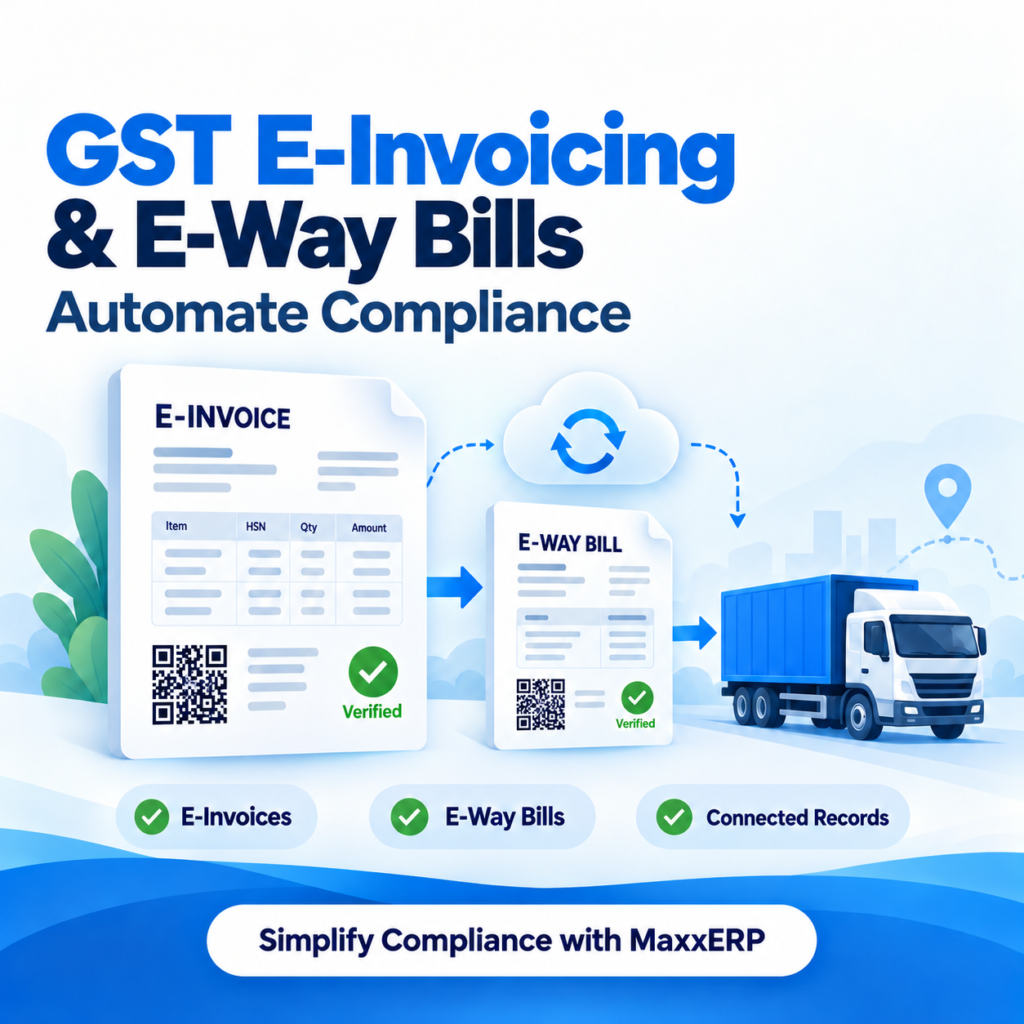
Rather than raising an invoice and separately uploading it to the government e-invoicing portal, MaxxERP generates the e-invoice as part of the regular billing process, attaching the required IRN (Invoice Reference Number) and QR code directly to the invoice — so compliance happens in the same step as the sale, not as a follow-up task.
Automated E-Way Bill Generation for Goods Movement
For shipments that cross the applicable value or distance thresholds, MaxxERP can generate the e-way bill directly from the same sales or dispatch transaction, carrying over vehicle number, transporter details, and consignment value without needing a second manual entry into a separate system.
HSN Code and Tax Rate Management at the Product Level
Every product in the system carries its own HSN code and applicable GST rate, defined once in the product master, so tax calculation is applied consistently across every invoice without relying on billing staff to select the correct rate manually each time.
Multi-Branch and Multi-GSTIN Support
For businesses operating across states or multiple registered branches, MaxxERP keeps GSTIN-wise transaction records separated and organized, so filing and reconciliation don't require manually sorting through a single combined ledger.
Return-Ready Reporting
Sales and purchase data is maintained in a structure aligned with standard GST return formats, reducing the manual reconciliation work typically needed before filing GSTR returns.
Audit Trail for Every Invoice and E-Way Bill
Every invoice, e-way bill, and any subsequent amendment is logged with a timestamp and user record, giving you a traceable history if a transaction is ever questioned during an audit.
Why This Matters Beyond Just "Staying Compliant"
- Fewer Delays in Goods Movement When e-way bills are generated automatically as part of the dispatch process, shipments aren't held up because someone forgot to raise one separately before the vehicle left.
- Reduced Risk of Penalties and Notices Consistent HSN coding, accurate tax application, and properly timed e-invoice generation reduce the chances of mismatches that typically trigger scrutiny or penalty notices later.
- Faster, Less Stressful Return Filing When invoice and purchase data is already structured correctly at the point of entry, monthly or quarterly return filing becomes a matter of review and submission, not weeks of manual data cleanup.
- Better Visibility Across Multiple Branches For businesses with more than one registered location, having GSTIN-wise records organized centrally means management doesn't have to chase separate reports from each branch to get a consolidated compliance picture.
- Less Dependency on a Single Person's Knowledge When compliance logic (HSN codes, tax rates, e-invoicing rules) is built into the system rather than held in one accountant's head, the business isn't as exposed if that person is unavailable during a critical filing period.
FAQs
The e-invoice, including the IRN and QR code, is generated as part of the regular billing process, removing the need for a separate manual upload step for each invoice.
The system only triggers e-way bill generation for transactions that meet the applicable value or distance thresholds, so you're not required to generate one for every single dispatch.
Yes — MaxxERP supports multi-branch and multi-GSTIN setups, keeping transaction records organized separately by registration while still giving centralized visibility.
No — it reduces the manual data preparation work involved, since sales and purchase records are already structured in a return-ready format, but final review and filing still benefit from accountant oversight, particularly for reconciliation and adjustments.
You update the tax rate once in the product master, and every invoice going forward automatically applies the new rate — there's no need to correct rates invoice by invoice.