
ERP software for pharmacy retail chains
ERP Software for Pharmacy Retail Chains: What to Look For
Why Pharmacies Can’t Run on Generic Retail Software
A pharmacy looks like a retail shop from the outside, but operationally it behaves very differently. Every product has a batch number and an expiry date. Prices are tied to a printed MRP that you can’t exceed. Some medicines can only be sold against a prescription, and certain categories need their own records. A single wrong strip handed over isn’t just a billing error; it can be a patient safety issue.
Now multiply that by five, ten, or fifty outlets. Stock moves between branches, purchases come from multiple distributors, and the owner needs one clear picture of what’s selling, what’s expiring, and where money is getting stuck. Generic billing tools and spreadsheets can’t carry that load for long. This guide breaks down what a pharmacy retail chain should look for in an ERP, so you can evaluate options based on what actually matters in this business, not on a long feature list built for a different industry.
What Makes Pharmacy Operations Different
Before comparing software, it helps to name the specific pressures a pharmacy chain deals with every day:
- Stock is only sellable until its expiry date, so a medicine sitting in the wrong branch is a direct financial loss.
- The same medicine often exists in several batches with different expiry dates and sometimes different MRPs.
- Pricing is capped at MRP, so margin management depends on purchase terms and scheme discounts, not on setting your own price.
- Some medicine categories require prescription details and record-keeping that must be accurate and easy to retrieve.
- Distributors offer schemes, free quantities, and discounts that need to be captured correctly at purchase time.
- Expired or near-expiry stock often has to be returned to the distributor, and that process needs proper tracking.
An ERP built for this environment needs to handle these as core workflows, not as workarounds.
What to Look For in a Pharmacy ERP
Batch-Wise Stock with Expiry Tracking
This is the foundation. Every purchase should be recorded with its batch number and expiry date, and every sale should deduct from the right batch. Look for a system that shows batch-wise stock clearly and warns you before stock expires, not after, so nothing quietly runs out of date on the shelf.
Expiry-First Billing (Selling the Oldest Stock First)
When the same medicine exists in multiple batches, the system should guide the counter staff toward the batch closest to expiry, and it should block the sale of anything already expired. This single control prevents a large share of avoidable write-offs and keeps older stock moving first.
Near-Expiry Alerts and Reports
You need a report that shows which products will expire in the next 30, 60, or 90 days, and in which branch. That gives you time to push the stock, transfer it to a faster-moving outlet, or arrange a return to the distributor, before it turns into a direct loss on your books.
MRP and Margin Control
Because you can't sell above MRP, your profit lives in the purchase price. The ERP should track MRP, schemes, and free quantities for each batch, and alert you when a purchase comes in at a thinner margin than expected, so you catch it at purchase time and not at month-end.
Smart Reordering
Reordering by memory leads to both stock-outs and overstock. Look for reorder levels per product, vendor-wise ordering lists, and reports that show what is running low and what is moving slowly, so every purchase decision is based on real data and not on guesswork or habit.
Multi-Branch Visibility and Stock Transfers
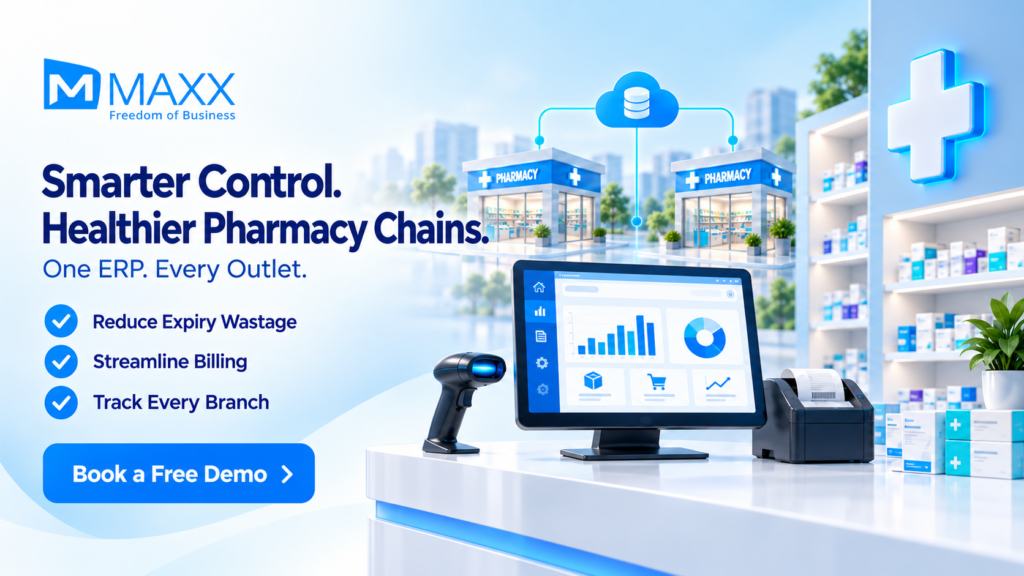
For a chain, the owner should see stock, sales, and expiry exposure across all outlets from one place, and move stock between branches with a proper record. This way, slow stock sitting in one outlet can become a sale in another, instead of expiring quietly on the shelf.
Why the Right ERP Matters for a Pharmacy Chain
- Lower Wastage from Expiry Early alerts and expiry-first selling directly reduce the stock you have to write off, which is one of the biggest hidden costs in pharmacy retail.
- Stronger, More Predictable Margins When purchase cost, scheme benefits, and MRP are tracked together, you see your true margin per product and per supplier, and you can negotiate with distributors using real numbers.
- Fewer Billing and Dispensing Errors Batch-aware billing and expired-stock blocks reduce the chance of the wrong batch or an expired product reaching a customer.
- One View Across Every Outlet Owners and managers stop chasing branch-wise reports and instead see consolidated stock, sales, and expiry data in one place.
- Faster Month-End and Compliance Work With clean records captured at the time of purchase and sale, returns, audits, and inspections become a matter of pulling reports, not reconstructing history.
FAQs - ERP Software for Pharmacy Retail Chains
Standard billing tools usually track stock at the product level only. A pharmacy needs batch-level and expiry-level tracking, MRP controls, and often prescription records, which general retail software doesn't handle well.
By tracking expiry date for every batch, flagging near-expiry stock in advance, and guiding billing toward the oldest batch first. That gives you time to sell, transfer, or return stock before it becomes a loss.
A good pharmacy ERP supports multi-branch operations with a consolidated view and recorded stock transfers, so you can rebalance inventory across outlets instead of letting it expire in one.
Yes, when purchase price, scheme discounts, free quantities, and MRP are all captured at purchase time, you can see the real margin per batch and per supplier, instead of estimating it.
A single outlet can often be live within a few weeks. For a chain, a phased rollout starting with a pilot outlet is the safer approach, since it lets you confirm stock accuracy and train staff before expanding.